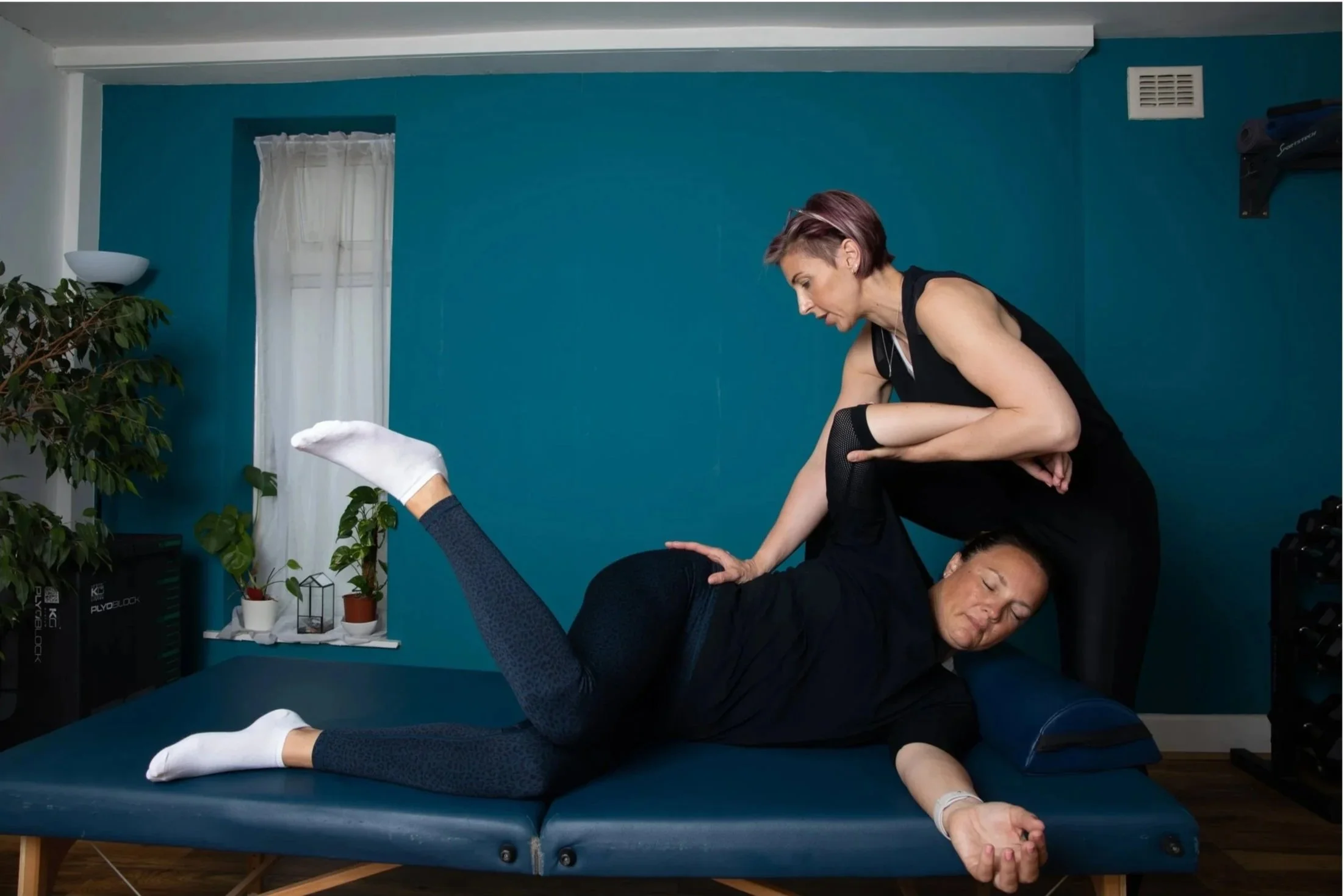
Understanding Clinical Somatics
How Integrated Clinical Somatics Works
Integrated Clinical Somatics is based on the work of Thomas Hanna, who observed that many patterns of chronic muscular tension are not simply “tight muscles,” but learned patterns held within the nervous system.
Human movement is shaped by repetition.
Every time we move in a particular way, the brain strengthens the neural pathways responsible for that movement. With repetition, those pathways become more efficient. Part of this efficiency involves the laying down of myelin, a fatty insulating layer around nerve fibres that allows electrical signals to travel more quickly and reliably.
In simple terms, the more we repeat a movement or behaviour, the more deeply it becomes embedded.
This is helpful when we are learning a skill, playing an instrument, training in the gym, refining a technique. But the same process applies to protective or stress-related patterns.
For example, if you injure your ankle and begin limping, the limp initially protects the injured tissue. The altered gait reduces load and feels safer. But if that pattern continues long enough, the nervous system strengthens the neural pathway responsible for it. Even once the ankle has healed, the limp may persist because it has been neurologically reinforced.
The body has learned it.
Integrated Clinical Somatics works with this principle of learning, and relearning.
Sensory Motor Amnesia (SMA)
Thomas Hanna used the term Sensory Motor Amnesia (SMA) to describe what happens when habitual muscle contraction becomes so familiar that we lose clear sensory awareness and voluntary control of it.
It is not a diagnosis. It is a description of habituation.
When a muscle is repeatedly activated, through stress, injury, posture, or emotional experience, the neural pathway responsible for that contraction strengthens. Over time, that contraction may occur below conscious awareness. We no longer clearly sense how much we are holding it.
In contemporary language, this can be understood as a learned motor pattern maintained through cortical and subcortical regulation. The muscle is not structurally “stuck.” It is being controlled in a way that has become habitual.
Integrated Clinical Somatics aims to bring that pattern back into awareness so it can be voluntarily modulated again.
The Three Stress Reflex Patterns
Hanna described three common whole-body stress responses that can become habitual over time:
Red Light Reflex: often associated with a forward, protective pattern of withdrawal or bracing.
Green Light Reflex : often associated with extension and over-efforting.
Trauma Reflex: typically a side-bending or asymmetrical protective pattern.
These are not medical conditions. They reflect common human responses to stress, injury, or experience. We might better describe them as learned neuromuscular adaptations shaped by repeated activation of protective responses.
The issue is not that these patterns exist, they are useful and adaptive in the right context. The issue arises when one pattern becomes dominant and limits movement variability.
Integrated Clinical Somatics works to increase movement options so that no single protective strategy remains fixed.
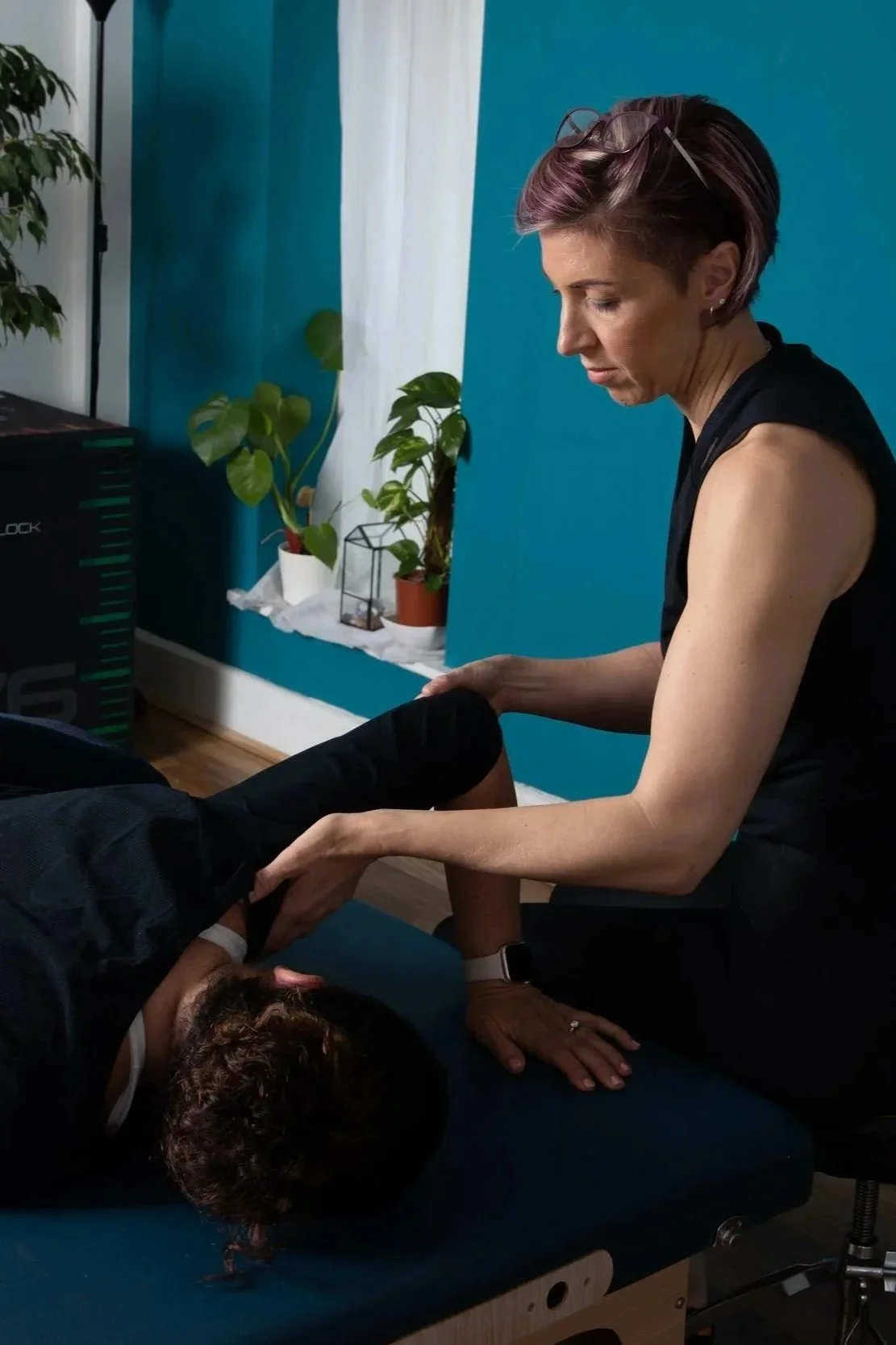
Pandiculation and Neuromuscular Regulation
The primary tool in Integrated Clinical Somatics is pandiculation.
Pandiculation is an active, conscious contraction of a muscle followed by a slow, controlled release. Rather than stretching a muscle from the outside, you gently contract it yourself and then gradually release it with attention.
From a theoretical perspective, this may influence how muscle tone is regulated within the nervous system. Muscle contraction is driven by alpha motor neurons, while muscle spindle sensitivity, which influences resting tone, is regulated through gamma motor neurons. In typical movement, these systems work together through alpha–gamma co-activation.
When a muscle has been habitually contracted, its baseline tone may be maintained through these regulatory loops. Simply pulling on the muscle does not necessarily change that baseline setting.
By consciously contracting and slowly releasing the muscle, pandiculation may help recalibrate this system. The focused attention involved also engages cortical networks responsible for motor planning and sensory discrimination. Awareness itself can influence muscle activation patterns.
Research specifically examining pandiculation mechanisms is still developing. However, principles of motorlearning, neuroplasticity, and sensory-motor integration support the idea that attentive, voluntary movement can influence coordination and muscle tone.
Awareness, Not Performance
Integrated Clinical Somatics isn’t about fixing posture or chasing ideal alignment. It’s about understanding how you organise your body and whether that’s limiting your options. Where it can get confusing is when it becomes about “doing the movements correctly. Integrated Clinical Somatics isn’t not about performing a sequence perfectly. It’s about learning to sense your own patterns.
Two people can look identical on the outside and be having completely different internal experiences. The work isn’t in copying a shape, it’s in recognising how you brace, how you hold, how you effort, and how you release.
That awareness is the work.
Integrated Clinical Somatics can absolutely help retrain habitual patterns and create new movement possibilities. But the movements themselves aren’t the whole story. If we’re still living under constant stress, moving in the same repetitive ways, sleeping poorly, or staying unaware of our bracing patterns, old habits can creep back in.
The movements open a door.
What you do next matters.
Often people feel a shift, sometimes straight away. A bit more space. Less background tension. A new sense of ease. What’s important isn’t just the feeling itself, but recognising it. That becomes a reference point. A sense of “oh… this is possible” and this is possible often leads to “there is hope” as change is possible.
From there, things start to translate into everyday life, how you sit, how you breathe, how you respond when stressed, how you train, how you rest.
Integrated Clinical Somatics isn’t about “doing exercises” in the traditional sense. It’s about experiencing yourself differently. It creates a space where you can notice how you’re organising your body and gently experiment with change.
Habituated patterns don’t exist in isolation. They’re shaped by sleep, stress, workload, emotional strain, recovery, all of it and Integrated Clinical Somatics can become a doorway into broader change. Not because it fixes everything, but because it helps you notice.